
2026 Top Battery Testers for Global Buyers
Choosing reliable Battery Testers in 2026 requires more than comparing prices or screen sizes. Global buyers need instruments that measure capacity, voltage, internal resistance, cycle life, and charging behavior with repeatable results. A compact handheld tester may suit a repair bench. A multi-channel analyzer fits laboratories, production lines, and battery research teams. The best choice depends on chemistry, testing current, cell format, software, and regional power requirements.
Dr. Jeff Dahn, a leading battery researcher at Dalhousie University, has stated, “The battery is the most important component of an electric vehicle.” His observation also applies to testing equipment. Poor measurements can hide weak cells, unsafe temperature rise, or declining capacity. Reliable Battery Testers should provide calibrated readings, clear data exports, thermal monitoring, and protection against overcurrent conditions. Buyers should also examine support, warranty coverage, replacement leads, and software compatibility. Small details matter.
A warm connector matters.
This guide compares leading models for international buyers. It considers laboratory precision, workshop practicality, automation, portability, and total ownership cost. It also looks at testing across lithium-ion, LiFePO4, nickel-metal hydride, and lead-acid batteries. No ranking is perfect. Real-world performance can change with cables, ambient temperature, operator training, and software updates. That limitation deserves attention. A tester that performs well in a climate-controlled laboratory may behave differently beside a busy workshop window. Buyers should verify specifications independently, request calibration evidence, and match each device to its actual workload. Careful testing is slower than guessing, but far less expensive than trusting a misleading result.
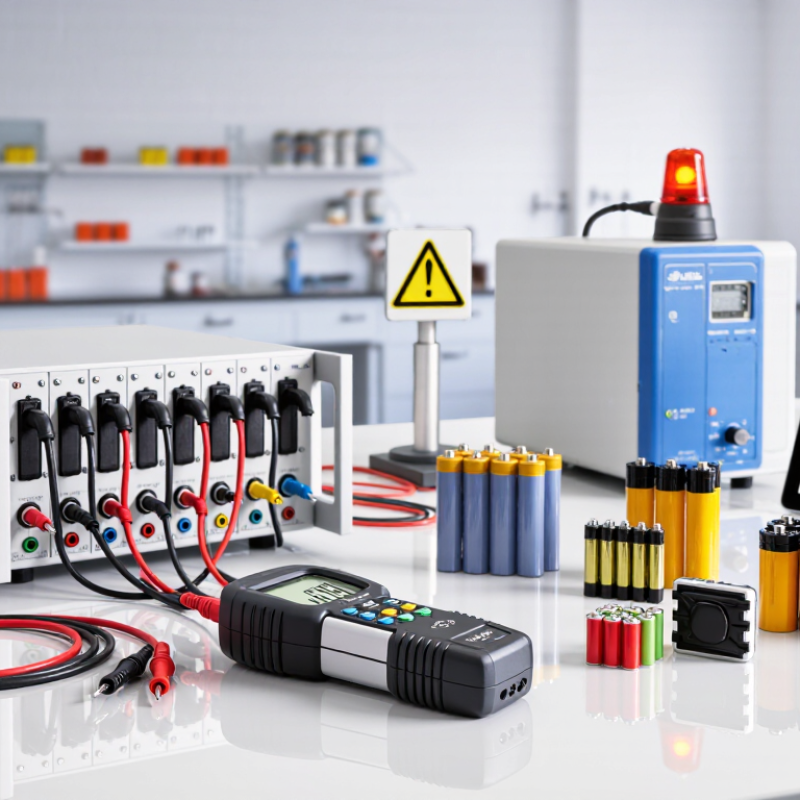
Battery Tester Fundamentals and Key Performance Criteria
A battery tester applies controlled current, measures voltage, and records how a cell behaves over time. Capacity testing remains fundamental, but it cannot stand alone. The International Energy Agency’s Global EV Outlook 2024 reported battery demand above 750 GWh in 2023, rising about 40% year on year. Such scale makes repeatable testing essential across laboratories, factories, and service centers.
Look for accurate current control, fine voltage resolution, and stable temperature monitoring. A four-wire measurement system can reduce cable resistance errors during high-current testing. Impedance analysis may reveal aging before capacity falls noticeably. Safety functions should include over-temperature protection, emergency shutdown, isolation monitoring, and automatic test limits. Data logging also matters. Engineers need time-stamped results, calibration records, and exportable files for traceability under ISO/IEC 17025 practices.
Small errors become expensive.
A tester rated for high current is not automatically precise. Check accuracy across the full operating range, not only at maximum output.
The U.S. Department of Energy’s battery research guidance repeatedly emphasizes controlled temperature and repeatable cycling when comparing performance.
Yet real workshops often have airflow changes, loose fixtures, or poorly maintained sensors. That weakens confidence in otherwise impressive data. A practical buyer should test reference cells, inspect thermal uniformity, and verify calibration intervals before large-scale purchasing. Perfect measurement is still an illusion. Reliability comes from disciplined verification.
Major Types of Battery Testers for Different Applications
Battery testers vary by the question they answer. A voltage tester checks a battery’s surface voltage quickly. It suits routine inspections, but voltage alone can mislead. A weak battery may show normal voltage after charging.
Capacity testers apply a controlled load and measure usable energy over time. They are common in backup power systems, electric vehicles, and production checks. Testing may take several hours. Temperature must be recorded because cold cells often deliver less capacity.
I have seen operators blame the battery when poor cables caused the real loss.
Impedance and conductance testers provide faster condition checks. They help maintenance teams find aging cells without fully discharging them. However, readings can change with battery temperature, terminal corrosion, and connection pressure.
Portable analyzers combine voltage, current, resistance, and discharge functions. They support laboratory work and field service, but their settings require careful review. A wrong discharge limit can damage a healthy battery.
For industrial banks programmable load testers offer precise current control and detailed reports. They suit acceptance testing and scheduled maintenance.
Solar storage systems may require testers that monitor several cells together.
Automotive workshops often prefer compact testers with clear pass-or-fail indicators.
That result is useful, not absolute. Calibration records, suitable test leads, and repeat measurements make the data more reliable. Some users skip these steps. That remains a costly weakness.
Essential Features for Global Purchasing Decisions
2026 Top Battery Testers for Global Buyers
Essential Features for Global Purchasing Decisions
Global battery purchasing now demands evidence, not impressive specifications. The International Energy Agency reported that electric-car sales exceeded 17 million in 2024, while electric-vehicle battery demand surpassed 1 TWh. This scale increases pressure on incoming inspection, production testing, and field diagnostics.
A suitable tester should cover the buyer’s voltage and current range without operating near its limits. Four-wire measurement improves accuracy when cables warm during high-current tests. Look for stated uncertainty, traceable calibration, and automatic data export. These details matter when suppliers compare capacity, internal resistance, and cycle performance across countries. IEC 62619 safety requirements can guide industrial battery evaluations, while ISO/IEC 17025 calibration records strengthen purchasing confidence.
Safety features deserve equal attention. Independent overvoltage, overcurrent, reverse-polarity, and thermal protections reduce avoidable damage. A tester should also record operator identity, time, temperature, test profile, and abnormal events. That audit trail helps resolve disputes across time zones. Multilingual software is useful, but clear data fields matter more. Support for local power standards and replaceable fixtures can reduce installation delays. Battery pack dimensions vary widely.
In practical testing, the most expensive mistake is often poor comparability. A faster instrument may produce weaker decisions if its algorithms are hidden. Buyers should request sample reports, uncertainty budgets, calibration intervals, and service response times. No tester is perfect. Some advertised accuracy declines near the lowest measurement range, and that limitation should be disclosed before purchase. Forecasts also change, so flexible firmware and modular channels may offer better long-term value.
2026 Top Battery Testers for Global Buyers - Essential Features for Global Purchasing Decisions
| Tester Category | Typical Battery Applications | Voltage Range | Current Capability | Key Measurement Functions | Typical Accuracy | Temperature Capability | Safety and Protection Features | Global Purchasing Considerations |
|---|---|---|---|---|---|---|---|---|
| Portable Battery Analyzer | Lead-acid, lithium-ion, nickel-metal hydride, and other field-service batteries | Usually up to 60 V DC | Low test current; commonly based on conductance, impedance, or pulse methods | Open-circuit voltage Internal resistance State of health State of charge | Generally suitable for service screening; accuracy depends strongly on battery chemistry, temperature, and test method | Often supports ambient operation; some models include temperature compensation | Reverse-polarity protection, overvoltage detection, insulated probes, automatic shutdown | Check supported chemistries, probe types, display language, rechargeable battery regulations, and calibration documentation |
| DC Electronic Load Tester | Single cells, battery packs, power banks, backup batteries, and small DC power systems | Commonly 0–60 V DC; higher-voltage versions are available | From several amperes to hundreds of amperes, depending on capacity and cooling | Capacity discharge Constant current Constant power Cutoff voltage | Typically specified as a percentage of reading plus a percentage of full scale | Internal temperature monitoring is common; forced-air cooling is used for higher power | Overtemperature, overcurrent, overvoltage, reverse connection, and programmable cutoff protection | Review input connector standards, cooling requirements, mains voltage, software compatibility, and replacement fan availability |
| Battery Charge-Discharge Cycler | Cell research, battery-pack validation, product development, and life-cycle testing | From millivolt-level channels to hundreds of volts, depending on system architecture | From milliampere channels to high-current pack testing; regenerative systems can return energy to the grid | CC-CV charging Discharge curves Cycle life Coulomb counting Energy efficiency | Laboratory systems commonly provide high-resolution voltage and current measurement; exact limits must be verified per channel | Usually supports external temperature sensors; chamber integration may be available | Independent channel cutoff, emergency stop, isolation monitoring, interlocks, overcurrent, and overtemperature protection | Confirm channel count, synchronization, data export format, automation interface, calibration traceability, and service support in the destination region |
| Battery Impedance and Conductance Tester | Stationary lead-acid batteries, UPS systems, telecom batteries, and maintenance inspections | Often designed for low-voltage battery strings and individual cells | Uses small-signal or pulse measurement rather than sustained high-current discharge | AC impedance Conductance Terminal voltage Trend recording | Repeatability and temperature compensation are important for detecting changes over time | Portable units may operate across a broad ambient temperature range; temperature sensing improves comparability | Short-circuit protection, incorrect-connection warnings, input protection, and data retention | Verify whether results are chemistry-specific, whether test leads are replaceable, and whether reporting software supports local operating systems |
| Battery Internal Resistance Meter | Incoming inspection, cell matching, production-line screening, and maintenance checks | Typically intended for individual cells and low-voltage modules | Low-current measurement using two-wire or four-wire techniques | DC resistance AC resistance Voltage Pass/fail limits | Four-wire Kelvin measurement generally reduces the influence of lead and contact resistance | Performance can vary with temperature; controlled test conditions are recommended for precise comparisons | Overvoltage input protection, lead detection, contact-quality checks, and measurement-limit alarms | Check measurement bandwidth, fixture compatibility, barcode or database integration, and calibration interval requirements |
| Battery Pack End-of-Line Tester | Manufacturing inspection of assembled battery modules and packs | Configured to the pack design; low-voltage and high-voltage systems require different safety architectures | May combine low-current electrical checks with controlled charge or discharge functions | Insulation resistance Wiring check Cell voltage balance BMS communication | Must be matched to production tolerances and the measurement uncertainty budget | Usually used in controlled factory environments; thermal sensors may be connected to the test fixture | Guarded fixtures, door interlocks, emergency stop, insulation monitoring, safe discharge, and fault logging | Assess local electrical codes, operator training, fixture changeover time, traceability, cybersecurity, and integration with manufacturing systems |
| High-Voltage Battery Test System | Electric-vehicle modules, traction battery packs, energy-storage systems, and high-voltage prototypes | Often hundreds of volts DC; exact range must match the battery architecture and test plan | From moderate current to high-power charge and discharge, depending on system rating | Performance testing Regenerative discharge Pulse testing Isolation monitoring | High-power systems require verified voltage, current, timing, and synchronization specifications | Typically integrates with thermal chambers, coolant control, and multiple temperature channels | High-voltage interlocks, pre-charge control, discharge circuits, insulation monitoring, emergency shutdown, and guarded access | Confirm grid requirements, harmonics, cooling infrastructure, regional safety certification, installation space, and technical commissioning support |
| Battery Safety and Abuse Test System | Validation of cells, modules, and packs under abnormal electrical or thermal conditions | Selected according to the device under test and applicable test method | May include controlled short-circuit, overcharge, over-discharge, or forced-current functions | Overcharge Over-discharge Short-circuit Thermal monitoring | Measurement accuracy must be adequate for the applicable safety procedure and acceptance criteria | Often requires thermal chambers, fire-resistant enclosures, gas detection, ventilation, or remote monitoring | Blast-resistant enclosure, remote operation, smoke and gas detection, fire suppression provisions, and emergency isolation | Verify applicable national and international test standards, facility permits, exhaust requirements, insurance conditions, and operator certification |
| Production Battery Grading System | Cell sorting, capacity grading, matching, and quality control in battery manufacturing | Usually optimized for single cells or low-voltage parallel fixtures | Multi-channel current capability; total output depends on the number of channels and selected test profile | Capacity grading Voltage sorting Resistance screening Batch tracking | Channel-to-channel consistency, repeatability, and calibration stability are critical for sorting accuracy | Temperature sensing and environmental control may be used for tighter production tolerances | Channel-level cutoff, fixture detection, abnormal-temperature alarms, current limiting, and data backup | Compare throughput, channel density, fixture replacement cost, database connectivity, local service response, and spare-part lead time |
Safety, Compliance, and International Testing Standards
For global buyers, a top battery tester must support safety, compliance, and repeatable evidence. The IEA’s Global EV Outlook 2024 reported that battery demand for electric vehicles exceeded 750 GWh in 2023. Demand is rising fast. Test equipment must therefore handle higher currents, tighter temperature control, and longer cycling schedules.
Compliance begins with the intended market and battery type. A capable system should help laboratories verify requirements under IEC 62133-2, IEC 62619, and UN 38.3 transport testing. It should record voltage, current, temperature, capacity, and failure events with traceable timestamps. ISO/IEC 17025 also matters. Equipment alone does not create an accredited result. Calibration records, validated methods, and trained operators remain essential.
Small details reveal quality. A loose thermocouple can hide a dangerous temperature rise. Poor channel synchronization can distort capacity comparisons. The IEA’s Global EV Outlook 2024 also noted continued growth in battery manufacturing and deployment, increasing pressure for consistent quality control. Battery pack prices fell to about 115 dollars per kWh in BloombergNEF’s 2024 Battery Price Survey, yet lower costs should not weaken testing discipline. A perfect test plan is unrealistic. Human error still happens. Buyers should review uncertainty budgets, software audit trails, emergency shutdowns, and service support before purchasing. The most useful tester is not merely powerful; it produces defensible data across laboratories, climates, and regulatory markets.
2026 Top Battery Testers for Global Buyers: Safety, Compliance, and International Testing Standards
Comparison of widely referenced international battery-testing frameworks by the main compliance area they address. Higher values indicate broader coverage across safety, transport, industrial, and automotive applications—not a ranking of manufacturers.
UN 38.3 focuses on lithium battery transport testing, IEC 62133-2 covers portable sealed secondary lithium cells and batteries, IEC 62619 addresses industrial lithium batteries, ISO 12405 covers electrically propelled road-vehicle battery systems, and UL 2580 addresses electric-vehicle battery safety.
How to Select the Best Battery Tester in 2026
2026 Top Battery Testers for Global Buyers
How to Select the Best Battery Tester in 2026
Selecting a battery tester in 2026 requires more than checking its advertised accuracy. Start with the battery types used in your facility, including lithium-ion, nickel-metal hydride, lead-acid, or primary cells. The tester must match the voltage range, capacity range, and testing current required for daily work. A device designed for small button cells may perform poorly on automotive batteries.
Accuracy matters, but repeatability matters more. Ask for test data from controlled conditions. Check whether the instrument supports calibration, temperature compensation, and traceable measurement records. In practical testing, a reading that changes sharply between identical samples signals a problem. Small errors can become expensive when hundreds of batteries are inspected.
Look closely at the operating details. A clear display helps in a bright warehouse. Protected terminals reduce accidental damage. Automatic test profiles save time, while manual settings support engineering analysis. Data export is useful for tracking aging, failed batches, and warranty evidence. Safety features should include current limits, reverse-polarity protection, and secure connections.
I once trusted a tester because its specifications looked impressive. The workflow was slow, and its cables loosened during repeated testing. That experience changed my selection process. Test the tester with real samples before purchase. Ask operators to use it for a full shift. A perfect specification sheet cannot reveal every practical weakness.
