10 Best PDLC Window Film Manufacturers for Global Buyers
Choosing the right Pdlc Window Film manufacturer is not a simple price comparison. Global buyers must examine product performance, production experience, technical support, and delivery reliability.
This guide introduces 10 leading manufacturers serving commercial, residential, hospitality, healthcare, and vehicle applications. Each company is considered through practical buying factors, including film clarity, switching speed, haze levels, voltage requirements, adhesive quality, and available sizes. These details matter when a glass partition must change from transparent to private within seconds.
Real projects often reveal more than promotional brochures. A reliable manufacturer should provide samples, installation guidance, electrical specifications, test reports, and clear warranty terms. Buyers should also confirm packaging standards and export experience before placing large orders.
Small details matter.
The selection also considers customization capabilities. Some projects need laminated glass integration, unusual dimensions, smart-home compatibility, or regional voltage support. A manufacturer with responsive engineers can prevent costly mistakes during installation.
However, no ranking is perfect. Supplier performance may vary by market, project scale, and production period. A company that fits a hotel renovation may not suit a high-volume distributor. Buyers should request recent samples and verify documentation independently.
This overview is designed to support careful, evidence-based decisions. It does not replace technical inspection or direct supplier communication. Instead, it provides a practical starting point for comparing manufacturers, reducing uncertainty, and identifying partners capable of delivering consistent Pdlc Window Film for global projects.
PDLC Window Film: Technology, Types, and Key Applications
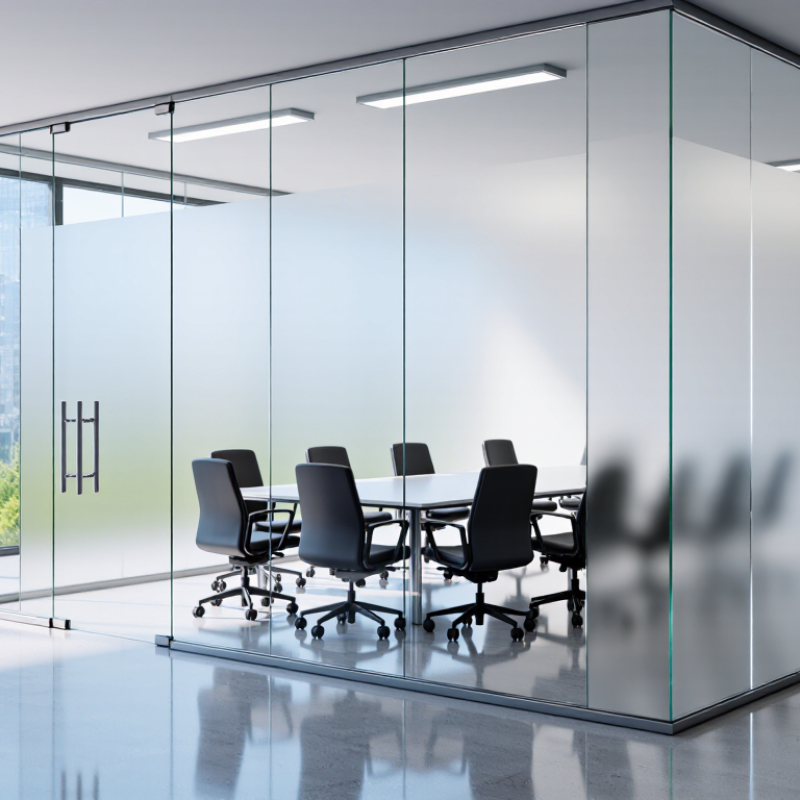
PDLC window film uses liquid-crystal molecules between conductive layers. When voltage is applied, the crystals align and the film becomes transparent. When power stops, it returns to a milky privacy state. This switching usually takes milliseconds. It also requires continuous electricity to remain clear.
The main types include adhesive retrofit film, laminated PDLC glass, and custom partitions. Retrofit film suits existing conference-room glass, while laminated units offer better durability in new construction. Field experience shows that edge sealing and wiring quality often matter more than advertised switching speed. A poor installation can create visible bubbles, uneven opacity, or premature failure.
Applications are expanding across offices, clinics, hotels, homes, and vehicle interiors. PDLC controls sightlines, not sunlight. Buyers still need blinds or solar-control glazing for strong heat reduction. Grand View Research valued the global smart-glass market at about $7.78 billion in 2023 and forecasts continued growth through 2030. MarketsandMarkets also projected the market to reach roughly $12.6 billion by 2028. These figures cover smart glass broadly, not PDLC alone. That distinction matters. Before purchasing, global buyers should request switching-cycle tests, haze measurements, power data, warranty terms, and installation records. Performance claims without test conditions deserve skepticism.
10 Best PDLC Window Film Manufacturers for Global Buyers - PDLC Window Film: Technology, Types, and Key Applications
| No. | PDLC Film Type or Application | Operating Principle | Typical Installation | Privacy State | Main Advantages | Important Specification Considerations | Best-Fit Environment |
|---|---|---|---|---|---|---|---|
| 1 | Adhesive Retrofit PDLC Film | Liquid-crystal molecules align under an electric field, allowing light transmission. Without power, the molecules scatter light and create a frosted appearance. | Applied directly to existing interior glass using a self-adhesive layer. Electrical busbars are connected to a suitable controller and transformer. | Clear when powered Frosted when switched off | Fast renovation, limited construction work, and the ability to upgrade existing partitions or windows. | Glass must be clean, flat, and compatible with the adhesive. Edge sealing, cable routing, and visible busbars should be planned carefully. | Offices, meeting rooms, clinics, and residential renovations |
| 2 | Laminated PDLC Smart Glass | PDLC material is permanently laminated between glass layers and protected from direct handling and environmental exposure. | Installed as a factory-produced glazing unit or laminated panel during new construction or refurbishment. | Switchable privacy Power state depends on the control system | Clean appearance, better mechanical protection, and a more integrated architectural finish than surface-applied film. | Consider glass thickness, safety glazing requirements, edge protection, wiring paths, and replacement procedures. | Hotels, hospitals, premium offices, and architectural interiors |
| 3 | Interior Office Partition Film | Electronic switching changes a transparent conference-room or workstation partition into a translucent privacy screen. | Usually installed on fixed tempered, laminated, or annealed interior glass partitions. | Instant visual privacy Typically controlled by wall switch, remote, or automation system | Supports open-plan layouts while allowing private meetings, presentations, and flexible space management. | Privacy is visual rather than acoustic. Door gaps, side openings, and ceiling gaps may still allow visibility or sound transmission. | Corporate offices, coworking spaces, banks, and reception areas |
| 4 | Healthcare Privacy Film | Switchable opacity provides on-demand visual separation without requiring curtains or manually operated blinds. | Applied to consultation-room windows, examination-room partitions, observation areas, and selected doors. | Frosted on demand Can return to a transparent state for supervision | Easy-to-clean surface, improved patient dignity, and better visibility when privacy is not required. | Specify compatible cleaning agents, sealed edges, electrical safety, hygiene procedures, and local healthcare regulations. | Hospitals, clinics, dental practices, and diagnostic centers |
| 5 | Projection-Ready PDLC Film | The opaque state acts as a rear-projection or front-projection surface, while the transparent state restores normal visibility through the glass. | Installed on glass walls, partitions, or display windows with a projector positioned according to the optical design. | Opaque for projection Transparent for daylight visibility | Combines privacy, digital signage, presentations, and interactive visual communication in one surface. | Image quality depends on projector brightness, viewing angle, ambient light, film haze, surface uniformity, and screen size. | Showrooms, museums, education facilities, offices, and retail displays |
| 6 | Retail Display Window Film | Electronic switching changes the storefront from a clear window into a branded privacy or projection surface. | Applied to shopfront glazing or installed as laminated smart glass in display panels. | Clear or promotional screen Can conceal displays outside operating hours | Supports dynamic advertising, seasonal campaigns, privacy, and controlled views into the store. | Assess direct sunlight, thermal loading, cleaning frequency, viewing distance, controller access, and local signage rules. | Retail stores, showrooms, shopping centers, and exhibition venues |
| 7 | Hospitality and Meeting-Room Glass | PDLC switching provides rapid privacy control for guest rooms, bathrooms, lounges, and conference facilities. | Used on interior glazing, bathroom panels, sliding doors, and meeting-room partitions. | Guest-controlled privacy Can be integrated with room or building controls | Modern appearance, reduced reliance on curtains, and convenient control through switches, remotes, or automation platforms. | Control interfaces, fail-safe behavior, moisture exposure, cleaning requirements, and service access should be defined before installation. | Hotels, serviced apartments, restaurants, and event venues |
| 8 | Residential Smart Window Film | Switchable liquid-crystal technology provides controllable visual privacy for selected windows, doors, and interior partitions. | Typically installed on interior-facing glass where wiring and controller access can be concealed. | On-demand privacy Commonly operated by a switch, remote, or smart-home relay | Useful for bathrooms, bedrooms, home offices, entrance sidelights, and open-plan living spaces. | PDLC is primarily a privacy technology, not a substitute for blackout blinds or solar-control glazing. Night-time privacy and lighting should be evaluated separately. | Homes, apartments, villas, and home offices |
| 9 | Educational and Training-Space Film | Transparent partitions can become opaque for examinations, group work, presentations, or temporary room division. | Installed on classroom partitions, laboratory observation panels, library rooms, and training-room glazing. | Flexible visual separation Switching can be linked to room controls | Improves space flexibility while preserving daylight and allowing supervision when the glass is clear. | Specify impact-resistant glazing where required, protect controls from unauthorized use, and account for frequent cleaning and operation. | Schools, universities, laboratories, and training centers |
| 10 | Commercial and Architectural Façade Integration | Large-area PDLC glazing changes optical privacy across selected façade or interior zones through a low-voltage control system. | Generally implemented as custom laminated glazing or engineered panels rather than simple cut-to-size retrofit film. | Project-specific switching May be zoned for independent control | Creates a high-impact architectural feature and can provide controlled visibility in selected areas. | Evaluate wind load, thermal stress, glass structure, electrical zoning, uniformity across large areas, maintenance access, and building-code compliance. | Commercial buildings, airports, cultural facilities, and premium developments |
Technical note: Actual optical performance, switching speed, haze, visible-light transmission, operating voltage, power consumption, dimensions, warranty, and environmental ratings vary by construction and project design. Always verify the current technical datasheet and applicable safety standards before specification.