top of page

Best Gravel Suppliers in China for Global Delivery?

Choosing a gravel supplier in China is not just a price comparison. Buyers must check aggregate grading, moisture levels, packaging, port access, and delivery schedules. A sample that looks consistent in a photograph may behave differently in a concrete mix or on a construction site. Small details matter.

The logistics are substantial. UNCTAD’s Review of Maritime Transport 2024 reports that more than 80% of global merchandise trade by volume moves by sea, making freight planning central to international sourcing. The USGS Mineral Commodity Summaries also tracks construction sand and gravel as a major mineral commodity, underscoring its essential role in infrastructure. For buyers, reliable Gravel Delivery depends on more than the quarry: documentation, loading, transit handling, and clear communication all affect whether material arrives as specified. Delays happen. A good supplier explains risks early, not after a vessel sails.

This guide compares Chinese suppliers by product range, quality controls, export experience, and delivery support. It also asks practical questions: Can the supplier provide recent test results? Are shipment terms and lead times clear? Who handles inspection before loading? Those answers deserve evidence. I have not included a named expert quotation because I cannot verify a verbatim statement from a Gravel Delivery specialist; inventing one would undermine trust.

Best Gravel Suppliers in China for Global Delivery?

Understanding Gravel Types and International Supply Requirements

Gravel is not a single, interchangeable material. Crushed stone has sharp edges that can help it lock into road bases, while rounded river gravel is often selected for drainage or decorative use. Pea gravel feels smooth underfoot but may shift more easily on a sloped path. The right choice depends on the project, not just the quoted price. Ask for the particle-size range, fines content, and washing method. A sieve analysis is useful, but only when the supplier explains how the sample was taken. That detail is easy to miss.

International orders need close attention to moisture, contamination, and packing. Wet gravel can add unexpected shipping weight, while excess dust may affect concrete mixes or drainage performance. Buyers should confirm whether material ships in bulk or sealed bags, and check pallet dimensions and container loading limits. Request a recent test report, a clear product specification, and photos of the actual stockpile. Not just a showroom sample. Import documents and inspection rules differ by destination, so verify local requirements before dispatch. One imperfect point: test results can vary between batches, even at the same quarry. Agree on acceptable tolerances in writing, and consider an independent pre-shipment inspection for large orders.

How to Assess Gravel Suppliers in China

A reliable gravel supplier should be able to explain where material is quarried and how each grade is produced. Ask for a recent sieve analysis showing particle-size distribution, plus test results for moisture, fines, and durability. Compare those figures with your project specification, not just a product photo. Photos help, but they cannot confirm consistency. Ask whether samples come from routine production or were specially selected. That difference matters.

Check the supplier’s quality process with specific questions: How are batches labeled? How often are tests repeated? Who checks loading records? Request clear photos of the stockpile, weighing, and container loading, then compare them with the paperwork. For overseas delivery, confirm packaging, estimated shipment schedule, and who coordinates freight. Small details count. One awkward truth: a neat sample may not match a large shipment. I would leave room for uncertainty and arrange an independent inspection when order size or project risk justifies it. A delayed reply is not proof of poor quality, but vague answers deserve follow-up. Ask for evidence, not promises.

Best Gravel Suppliers in China for Global Delivery? - How to Assess Gravel Suppliers in China

Assessment Dimension What to Request or Confirm Evidence and Verification Method Practical Evaluation Signal
Product type and intended use Confirm whether the material is crushed stone, naturally rounded gravel, or another aggregate, and whether it suits the intended application. Request a product specification, source description, and representative sample. Compare them with the project specification and destination requirements. The supplier identifies the material clearly and checks suitability rather than offering one product for every application.
Particle size and grading Obtain the nominal size range and sieve-by-sieve grading limits, including the permitted proportion of oversized and undersized particles. Review a recent sieve analysis. ASTM C136/C136M and EN 933-1 describe aggregate sieve analysis methods; use the method and grading limits required by the project. Results are reported against stated limits and can be traced to a sample or production lot.
Fine particles and cleanliness Ask for the fines content and the agreed test method. Specify any limits for clay, silt, or other unwanted material in the purchase specification. Review test results; ASTM C117 is a method for material finer than the No. 200 (75 μm) sieve by washing. Applicable limits depend on the intended use and governing specification. The supplier reports measured results and does not treat “clean” as a substitute for a defined limit.
Strength and abrasion resistance For applications where wear resistance matters, confirm the required abrasion or fragmentation test and acceptance limit. Request relevant test results. ASTM C131/C131M or C535 and EN 1097-2 include Los Angeles abrasion or fragmentation test methods; applicability depends on aggregate size and specification. The test method, sample, result, and required limit are all stated; no universal pass value is assumed.
Density and water absorption Check whether specific gravity and absorption data are needed for mix design, quantity calculations, or product acceptance. For coarse aggregate, ASTM C127/C127M is a test method for relative density and absorption. Confirm the applicable method for the material and project. Data are provided when required and are consistent with the stated material and test basis.
Quality control and consistency Ask how production lots are identified, sampled, tested, and checked against the agreed specification. Review quality procedures, sample test reports, and lot traceability. A quality-management certificate, if provided, does not replace product testing or project acceptance. The supplier can link test records to identifiable production and shipment lots.
Production capacity and availability Confirm available quantity, production lead time, loading schedule, and ability to maintain the agreed grading for repeat orders. Request a written production and dispatch plan, plus shipment records or other verifiable evidence relevant to the proposed order. Capacity claims are specific to the product, quantity, and delivery window rather than broad estimates.
Export logistics and delivery terms Confirm shipping route, loading point, packaging or bulk-loading arrangement, estimated transit schedule, and the agreed Incoterms® rule and named place. Request a written quotation that separates product, packaging, inland transport, port, and ocean-freight costs where applicable. Confirm shipment details with the carrier or logistics provider. The quotation states what is included, who handles each transport stage, and where responsibility transfers under the agreed term.
Export and import documentation Agree which shipment documents will be supplied and check destination-country requirements before placing the order. Confirm applicable documents, which may include a commercial invoice, packing list, bill of lading, and certificate of origin. Import permits, declarations, and classification depend on the product and destination. Document responsibilities and timing are agreed in writing; requirements are checked with the importer or customs broker.
Packaging, loading, and quantity control Specify bulk or bagged delivery, bag size if applicable, moisture or contamination precautions, loading method, and how shipped quantity will be measured. Review the packing plan and agree the quantity measurement and inspection process before dispatch. Confirm the transport mode and packaging comply with carrier and destination requirements. Packaging and quantity terms are unambiguous and match the shipping arrangement.
Sampling, inspection, and claims Agree sample approval, pre-shipment inspection, test responsibility, acceptance criteria, and the process and time limit for reporting non-conformities. Put the sampling plan, test methods, tolerances, inspection access, and claims procedure in the contract or purchase order. Acceptance and remedy terms are written down before production or shipment.

Note: Acceptance limits for aggregate depend on the intended application, governing specification, and destination market. Agree the product requirements and test methods before ordering; no single grading or test threshold is suitable for every project.

Production Capacity, Quality Standards, and Product Range

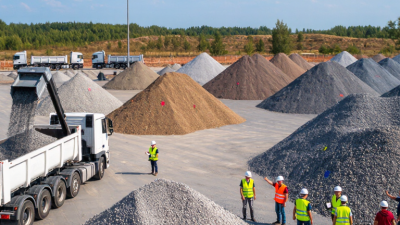
For global buyers, production capacity means more than a large quarry. Check monthly output, reserve stock, loading equipment, and port access. A supplier may quote ample tonnage, yet struggle to keep gradation consistent between shipments. Capacity on paper can mislead. The USGS Mineral Commodity Summaries 2024 estimated U.S. construction sand and gravel production at about 960 million metric tons in 2023, showing the scale of demand these supply chains serve. For Chinese suppliers, request recent production records and shipment schedules, not just a stated annual capacity.

Quality checks should match the intended use. Ask for sieve analyses, fines content, moisture, and crushing or abrasion test results, then compare them with the contract specification. China’s GB/T 14684-2022 covers sand; GB/T 14685-2022 covers gravel and crushed stone. For export projects, ASTM C33 or EN 12620 may also be relevant when specified by the buyer. A broad product range can include washed sand, crushed stone, gravel, and screening fines. But range alone proves little. I would request a representative sample and confirm that the tested material matches the loading stockpile. That extra step takes time, and it can still miss variation across a long shipment.

Export Documentation, Shipping, and Global Delivery

Global delivery starts with a clear cargo description. State the gravel’s size range, moisture condition, net weight, and packaging method consistently across the commercial invoice, packing list, and shipping instructions. A small mismatch can delay clearance. The World Bank’s 2023 Logistics Performance Index assessed 139 economies, including customs, infrastructure, shipment tracking, and timeliness. These factors matter when choosing a loading port and planning inland transport.

For bulk cargo, confirm vessel space, loading limits, discharge equipment, and the receiving site’s unloading capacity before booking. UNCTAD’s Review of Maritime Transport 2024 reports that seaborne trade grew 2.4% in 2023, reaching 12.3 billion tonnes. That scale does not guarantee a smooth journey for one shipment. Check the bill of lading details, certificate of origin requirements, and destination-specific import documentation with the freight forwarder and buyer. Small errors travel.

Keep records of cargo photographs, weight tickets, seals, and inspection results. They help resolve disputes if delivered quantities differ. I would still double-check the declared weight against the loading record; teams sometimes rely on figures copied from an earlier shipment. That shortcut is tempting, but each load can vary. Share document drafts early, and confirm who handles customs declarations, port charges, and final-mile delivery in writing.

Comparing Suppliers by Cost, Reliability, and Service

Choosing a gravel supplier in China requires more than comparing the price per tonne. Ask for the delivered cost, including loading, inland transport, freight, and port charges. A low quote can lose its appeal when extra fees appear. Request the stone size range, grading details, and moisture limits in writing. For example, gravel intended for drainage may need consistent particle sizes, not just an attractive sample.

Reliability shows in repeatable quality and clear communication. Ask how each batch is checked and whether inspection photos or test records are available before dispatch. Confirm estimated production time, packaging, and what happens if cargo is delayed. Service matters too. A supplier who answers technical questions clearly can help prevent mismatched specifications. Still, polished replies are not proof of dependable delivery; verify details against sample results and shipping documents. I would not treat a single successful order as a guarantee.

Tips: Compare quotes using the same grade, quantity, and delivery point. Keep a sample and written specification for reference. Check response times before ordering. Small details matter. Some plans may still need adjustment once freight dates are confirmed.

Best Gravel Suppliers in China for Global Delivery?

A qualitative comparison of common supplier models by cost, delivery reliability, and service.

Scores are indicative planning ratings, not verified measurements or company-specific data. Actual performance depends on the quarry, product specification, order size, destination, shipping terms, and quality controls. Compare current written quotes and shipment references before choosing a supplier.

Concrete Products Unlimited

Mon-Fri 8AM - 5PM

Concrete products, wholesale Arizona river rock for landscaping, decorative rock, sand and gravel. Rock quarry located in Arizona and delivers throughout the USA.

©2003 by Concrete Products Unlimited

bottom of page