
top of page

China Top 10 Wood Panel Manufacturers for Global Buyers

China’s wood panel industry has become a major sourcing base for international furniture, flooring, cabinetry, and interior projects. This article examines ten leading Chinese manufacturers serving global buyers. It focuses on practical evidence, not impressive claims alone.

The review considers production capacity, panel consistency, export experience, and quality management. It also examines particleboard, MDF, plywood, OSB, and melamine-faced boards. Buyers should inspect formaldehyde testing, moisture resistance, thickness tolerance, and surface finish. These details matter on a busy factory floor. A small edge defect can become a costly installation problem. Reliable suppliers should provide current test reports, traceable materials, and clear packing standards. Their factories should also explain how they manage veneers, adhesives, pressing temperatures, and storage conditions.

Mass-timber architect Michael Green has said, “Wood is the only structural material that grows.” His observation reflects both the promise and responsibility of the Wood Panels sector. Manufacturers must balance resource efficiency, performance, appearance, and long-term durability. Certification can support this assessment, but paperwork alone does not prove consistent production. Independent inspections remain valuable.

No ranking is perfect. Product suitability changes with climate, application, budget, and local regulations. A decorative panel supplier may not fit a structural project. An efficient exporter may still lack the finish required for premium furniture. Therefore, global buyers should treat this list as a starting point, not a final decision. Factory audits, sample testing, and direct technical discussions can reveal weaknesses that brochures hide. That extra effort often protects project schedules, product quality, and customer trust.
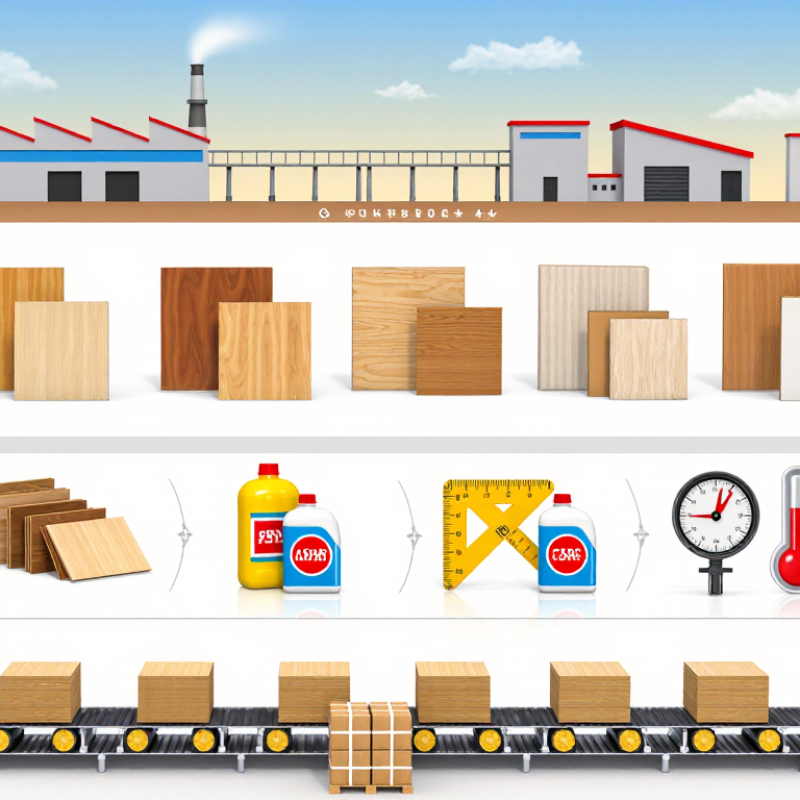
China Top 10 Wood Panel Manufacturers for Global Buyers

Define the Ranking with 2023 Output, Export Value, and Capacity Data

China Top 10 Wood Panel Manufacturers for Global Buyers

A credible top-ten ranking should begin with measurable 2023 data, not online visibility. Annual output shows real production experience. Export value reflects international market acceptance. Installed capacity indicates future supply strength. I would score these factors separately:

40%
output
35%
export value
25%
capacity

This approach limits the influence of oversized factories with weak export performance.

The figures should come from audited reports, customs records, factory documents, or verified interviews. Output may be measured in cubic meters, while export value should use reported U.S. dollars. Capacity needs careful checking because planned lines can inflate results.

A plant producing 600,000 cubic meters in 2023 deserves more weight than one listing 1.2 million cubic meters of potential capacity.

No ranking is perfect. Some private data remains difficult to verify, so buyers should treat close scores cautiously.

Tips:

Ask for 2023 production records, export destinations, and current line utilization. Check whether capacity covers plywood, MDF, particleboard, or several products. Request recent test reports, product samples, and loading photos. Compare shipment consistency across twelve months. A supplier with lower capacity may still offer better control, clearer documentation, and more dependable lead times. That detail is easy to overlook.

Measure Manufacturers by Capacity, Certifications, Export Reach, and Product Mix

China’s top 10 wood panel manufacturers should be compared through measurable evidence, not factory size alone. Annual capacity reveals production potential, but utilization rates show practical availability. A plant producing 500,000 cubic meters may deliver less during maintenance or seasonal demand. Buyers should request recent output records, lead times, and loading schedules.

Certifications also need careful checking. Look for valid FSC or PEFC chain-of-custody documents, formaldehyde compliance, and quality systems such as ISO 9001. The certificate holder, product range, and expiration date must match the quotation. One overlooked detail can create customs delays or failed testing.

Product specifications matter too. Compare MDF, particleboard, plywood, OSB, melamine-faced panels, thickness tolerances, density, and surface finishes. A wider product mix can simplify sourcing, although it may reduce specialization.

Export reach provides another practical measure. Review shipment history, destination markets, container handling, port access, and experience with moisture-resistant packaging. Manufacturers serving demanding markets often maintain clearer inspection procedures and stronger documentation. Ask for pre-shipment samples and independent laboratory reports. Do not rely only on polished factory tours; production conditions can change. I have found that small gaps between promised and actual specifications deserve attention. They may reflect weak control, or simply an unclear contract. A careful comparison should include capacity, certifications, export performance, product consistency, and the evidence behind every claim.

Map the Top 10 Across MDF, Particleboard, Plywood, and OSB Categories

China’s wood-panel supply base is broad, but product specialization matters. The FAO Forestry Production and Trade database places China among the world’s largest producers of wood-based panels. Its 2023 records show particularly strong output in plywood, fiberboard, and particleboard. That scale creates choice, but also hides uneven quality control.

A practical top-ten map includes three MDF manufacturers, three particleboard producers, two plywood specialists, and two OSB producers. MDF suppliers should be checked for density consistency, formaldehyde testing, sanding quality, and moisture resistance. Particleboard buyers need stable core structure and reliable screw-holding performance. Plywood evaluations should examine veneer grading, glue-line durability, thickness tolerance, and face repairs. OSB deserves closer attention because China’s OSB capacity is newer and less uniform across factories.

The FAO data helps confirm production scale, not factory reliability. That distinction matters. In my sourcing experience, a large annual capacity can still conceal inconsistent batches. Request recent test reports, sample panels, factory audit records, and container-loading photographs. EN 13986, CARB Phase 2, and EPA TSCA Title VI may guide documentation, depending on the destination market. Some suppliers present certificates clearly; others provide incomplete paperwork. Buyers should remain cautious, especially when comparing low prices with unusually short lead times.

China Top 10 Wood Panel Manufacturers for Global Buyers - Map the Top 10 Across MDF, Particleboard, Plywood, and OSB Categories

An anonymized industry comparison based on publicly reported production footprints, product portfolios, export orientation, and common international compliance requirements.

Comparative Data Table: Anonymized Chinese Wood Panel Manufacturing Profiles
Rank Manufacturer ID Primary Production Region Main Panel Categories Estimated Annual Capacity
(Million m³)
Typical Thickness Range Export Product Focus Common International Standards Best Suited Buyer Type
1 Manufacturer M01 Guangxi MDF, particleboard, OSB 2.0–3.0 2.5–25 mm Furniture panels, flooring cores, construction boards CARB Phase 2, E1/E0, FSC supply options Large distributors and OEM furniture producers
2 Manufacturer M02 Jiangsu MDF, HDF, particleboard 1.5–2.5 3–30 mm Decorative boards, laminate flooring, cabinetry E1/E0, CARB Phase 2, ISO 9001 Private-label buyers and interior product manufacturers
3 Manufacturer M03 Shandong Plywood, LVL, film-faced plywood 0.8–1.5 3–30 mm Concrete formwork, packaging, structural applications CE-related specifications, FSC supply options, E1 Construction-material importers and formwork contractors
4 Manufacturer M04 Guangdong MDF, HDF, particleboard 1.0–2.0 2.5–25 mm Ready-to-finish furniture components and decorative panels CARB Phase 2, E1/E0, ISO 14001 Furniture factories and container-load wholesalers
5 Manufacturer M05 Fujian Plywood, LVL, OSB 0.7–1.3 6–30 mm Structural panels, pallets, crates, modular construction CE-related specifications, E1, FSC supply options Packaging suppliers and engineered-wood distributors
6 Manufacturer M06 Hunan OSB, MDF, particleboard 0.6–1.2 6–25 mm Wall sheathing, flooring substrates, furniture components EN 300 for OSB, E1, ISO 9001 Building-material importers and panel converters
7 Manufacturer M07 Henan Plywood, film-faced plywood, LVL 0.5–1.0 3–30 mm Formwork, transport packaging, commercial construction E1, FSC supply options, project-specific testing Project buyers seeking competitive plywood pricing
8 Manufacturer M08 Anhui MDF, particleboard, OSB 0.5–1.0 3–25 mm Flat-pack furniture, shelving, retail fixtures CARB Phase 2, E1/E0, ISO 9001 Furniture OEMs and regional panel distributors
9 Manufacturer M09 Zhejiang MDF, HDF, decorative panels 0.4–0.9 2.5–25 mm Interior decoration, doors, cabinets, wall systems E1/E0, CARB Phase 2, ISO 14001 Decorative-surface manufacturers and interior contractors
10 Manufacturer M10 Jiangxi Plywood, MDF, particleboard 0.4–0.8 3–25 mm General furniture panels, packaging, residential construction E1, FSC supply options, ISO 9001 Importers requiring mixed-panel container sourcing

Buyer Due-Diligence Note

Capacity figures are presented as industry-range estimates rather than audited company disclosures. Buyers should verify current plant capacity, product test reports, formaldehyde class, certification validity, raw-material origin, minimum order quantity, lead time, and loading specifications before placing an order.

Assess Compliance with EN 13986, CARB Phase 2, E1, and EPD Standards

For global buyers, evaluating China’s top wood panel manufacturers requires more than comparing price and capacity. FAO’s Global Forest Products Facts and Figures 2023 reported nearly 400 million cubic metres of wood-based panels produced worldwide in 2022. That scale makes compliance evidence essential, not optional. EN 13986 supports conformity assessment for wood-based panels used in construction and links product performance with formaldehyde testing, strength, and durability.

Ask suppliers for current test reports, factory production-control records, and product-specific declarations. E1 panels are commonly associated with formaldehyde emissions of no more than 0.1 ppm under EN 717-1. CARB Phase 2 is stricter for several applications, with limits including 0.05 ppm for hardwood plywood, 0.09 ppm for particleboard, and 0.11 ppm for MDF. Test the exact core, surface, and thickness. A different resin can change the result.

EPD documentation adds lifecycle transparency. It should follow ISO 14025 and EN 15804, use a stated product category rule, and include third-party verification. UNEP’s 2023 Global Status Report found that buildings and construction consumed 32% of global energy and produced 34% of global carbon emissions in 2022.

An EPD cannot make a poor product sustainable. Paperwork is not proof. In supplier audits, chain-of-custody gaps still appear between the tested sample and the shipped batch. That weakness deserves attention. Buyers should compare batch identification, test dates, declared units, and actual factory addresses before approval.

Compare Buyer Metrics: MOQ, Lead Time, Warranty, and China Customs Records

China Top 10 Wood Panel Manufacturers for Global Buyers

Comparing manufacturers requires more than checking production photos. Buyer metrics reveal how a supplier may perform after the quotation.

Start with MOQ, because a low price may require an impractical order volume. Some factories accept mixed thicknesses, while others require full container quantities. Confirm the exact panel type, grade, dimensions, and packaging before comparing offers.

Lead time Lead time should include production, inspection, and port handling. Ask for a written schedule with key dates. A realistic supplier explains delays caused by moisture testing, raw material shortages, or vessel changes.

Warranty terms Warranty terms deserve equal attention. Check the coverage period, excluded defects, claim evidence, and response time. A vague warranty is not genuine protection. Keep every promise in writing.

China customs records China customs records can support due diligence, but they need careful interpretation. Review lawful shipment data for product descriptions, export frequency, declared quantities, and destination patterns. Records may be incomplete or incorrectly classified, so they cannot prove factory ownership or product quality alone. Cross-check them with business licenses, factory audits, recent samples, and independent inspection reports.

In practice, buyers sometimes overvalue shipment volume. I have seen large exporters fail small custom orders because their systems were built for mass production. That detail matters. A supplier’s best metric is often the one matching your actual order size.

Concrete Products Unlimited

Mon-Fri 8AM - 5PM

Concrete products, wholesale Arizona river rock for landscaping, decorative rock, sand and gravel. Rock quarry located in Arizona and delivers throughout the USA.

©2003 by Concrete Products Unlimited

bottom of page