
top of page

7 Tips for Buying a Vintage Metal Medical Cabinet?

Buying a Vintage Metal Medical Cabinet can add character, storage, and a strong industrial presence to a room. However, appearance alone does not reveal its true condition. A cabinet may look charming in photographs, yet hide rust beneath chipped paint or warped doors behind clean handles.

This guide presents seven practical tips for making a more informed purchase. It considers construction, dimensions, corrosion, shelving, hardware, provenance, and restoration costs. Examine close-up images of corners, drawer runners, hinges, and enamel surfaces. Ask whether the cabinet rocks on a level floor. Small details matter. A faint chemical odor, sharp metal edge, or loose glass panel deserves careful attention.

Condition is only one part of the decision. Confirm the cabinet’s measurements before delivery, especially when narrow doorways or staircases are involved. Check whether replacement parts are available. Old finishes can contain unknown coatings, so professional assessment may be sensible before sanding or repainting. Do not assume every mark adds authenticity. Some damage is simply expensive damage.

Reliable sellers should describe defects honestly and provide clear photographs. Written details about repairs, cleaning, and shipping protection can prevent misunderstandings. Still, buyers should verify claims independently. Even experienced collectors overlook problems when an unusual color or original label creates excitement. That is worth remembering. With patient inspection and realistic budgeting, a vintage medical cabinet can become a useful, distinctive piece rather than an attractive repair project.
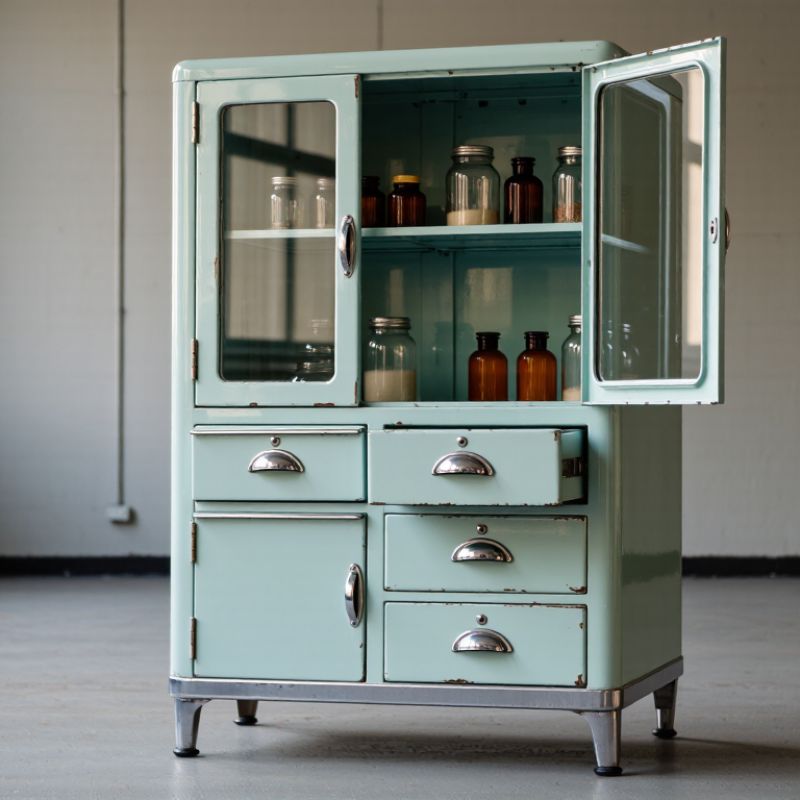
7 Tips for Buying a Vintage Metal Medical Cabinet?

Define Your Purpose and Choose the Right Cabinet Style

Before admiring chipped paint or old hospital labels, define the cabinet’s purpose. A display cabinet needs clear glass and attractive shelving. A workshop cabinet needs strong doors, deeper shelves, and easy cleaning. For bathroom use, inspect rust carefully. Moisture can turn a small bubble into a structural problem.

Measure the wall, doorway, and available floor space. Leave room for the door to open fully. Vintage medical cabinets often have narrow bodies but surprisingly heavy steel frames. Check shelf spacing, hinge movement, and maximum load before buying. A 2024 medical-furniture market report from Grand View Research identifies durability, storage efficiency, and cleanability as major purchasing factors. Those criteria still matter in a home setting. Choose enamel finishes for practical storage, or glass-front styles for visual display. Avoid selecting only by color.

Condition deserves equal attention. Look beneath shelves, around welds, and inside drawer channels. Light surface oxidation may be manageable, but soft metal signals deeper damage. The U.S. Environmental Protection Agency warns that older painted surfaces may contain lead, especially in buildings constructed before 1978. Do not sand unknown coatings indoors. Ask about previous use and request detailed photos. I once underestimated cabinet weight and damaged a doorway. That mistake still influences my measurements. A little less character may be wiser than a cabinet requiring extensive repair.

Inspect the Metal, Finish, and Overall Structural Condition

Tip 1: Inspect the metal in strong, angled light. Surface rust is usually manageable, but bubbling, deep pits, and flaking seams signal moisture damage. Press gently near the cabinet’s bottom corners. A soft or buckled area deserves caution. Check the back panel too; sellers often overlook it.

Tip 2: Study the finish rather than trusting attractive photographs. Original paint may show uneven fading, small scratches, and exposed edges from years of use. Fresh, glossy coating can hide repairs. Look inside shelves, beneath handles, and around hinge plates. If the surface feels powdery, request a professional coating assessment before handling it extensively. I once focused on a beautiful pale finish and missed rust beneath one shelf. That mistake changed my inspection routine.

Tip 3: Test the structure slowly. Open every door and drawer, listening for scraping or sudden drops. Hinges should move without twisting, while shelves must sit level and support their intended load. Examine casters, welds, legs, and fasteners for cracks or improvised replacements. Rock the cabinet gently on a flat floor. Excessive movement may indicate a distorted frame. Do not force stiff hardware; it can worsen hidden damage. A slightly imperfect cabinet can still be reliable, but only when its weakness is understood and documented. Take close photographs of problem areas, including measurements, before deciding.

Verify Dimensions, Storage Capacity, and Interior Features

7 Tips for Buying a Vintage Metal Medical Cabinet

Verify the cabinet’s external dimensions before admiring its patina. Measure height, width, and depth, then check door swing and wall clearance. A cabinet that fits a showroom may block a narrow hallway at home. The 2010 ADA Standards specify a 30-by-48-inch clear floor space for many accessible fixtures. This benchmark helps assess practical placement, even in private interiors. Record every measurement yourself. Old listings are sometimes wrong.

Storage capacity deserves equal attention. Measure usable shelf space, not the cabinet’s outer volume. Count shelves, examine their spacing, and test whether they adjust securely. NIOSH’s Revised Lifting Equation uses a 51-pound load constant under ideal lifting conditions. Heavy metal doors and dense contents can quickly create an awkward load. Keep frequently used items between waist and shoulder height. Inspect drawers for smooth travel and hidden corrosion. Look closely.

Interior features often separate useful restoration from decorative clutter. Check for removable trays, locking mechanisms, ventilation openings, and rounded shelf edges. Original paint may contain unknown coatings, so ask for professional material testing before disturbing it. A magnet test can reveal steel, but it cannot confirm structural safety. I have seen attractive cabinets with warped backs and loose hinges. That is easy to miss. Photograph the interior, measure each compartment, and note missing hardware before paying. A beautiful cabinet can still fail its storage job.

7 Tips for Buying a Vintage Metal Medical Cabinet? - Verify Dimensions, Storage Capacity, and Interior Features

Tip What to Verify Useful Measurement or Reference How to Check It Why It Matters
1 Confirm the exterior dimensions Check the overall height, width, and depth, including handles, hinges, feet, and any rear fittings. Common freestanding metal medical cabinets are approximately 60–72 in high × 24–36 in wide × 12–20 in deep (152–183 × 61–91 × 30–51 cm). Measure the cabinet itself rather than relying only on a listing description. Record the maximum dimensions at the widest, highest, and deepest points. Accurate measurements help confirm that the cabinet will fit the intended wall, room, doorway, elevator, and delivery route.
2 Measure usable interior space Verify the internal width, height, and depth after accounting for shelves, door liners, hinges, locks, and recessed areas. Usable depth is often less than exterior depth. A cabinet measuring 16 in deep externally may provide only about 12–14 in of clear interior depth. Open the doors fully and measure from the back panel to the nearest obstruction. Measure between the side walls, not from the outside edges. Interior measurements determine whether folders, containers, towels, tools, or display items will fit without interfering with the doors.
3 Estimate storage capacity Count shelves, compartments, drawers, and usable vertical sections instead of judging capacity from exterior size alone. A tall cabinet with 4–5 adjustable shelves commonly provides 5–6 storage levels. Shelf spacing of about 10–14 in (25–36 cm) suits many general storage items. Record the number of shelves and calculate each shelf area using: usable width × usable depth. Note whether the shelves are fixed, removable, or adjustable. This prevents a visually large cabinet from being unsuitable for the quantity or size of items you need to store.
4 Inspect interior features Look for adjustable shelves, drawers, dividers, label holders, raised lips, hooks, or specialized compartments. Adjustable shelf holes are typically spaced at regular intervals, often about 1–2 in apart. A shelf lip of approximately 0.5–1 in can help prevent items from sliding forward. Test every shelf position and remove the shelves if possible. Check that drawers open fully and that dividers are secure and not sharply bent. Functional interior fittings improve organization and make the cabinet more adaptable for modern storage needs.
5 Check doors, hinges, and lock hardware Verify that doors close evenly, hinges are not loose, and the lock, latch, handle, or key mechanism operates correctly. Allow at least 24–30 in (61–76 cm) of clear space in front of the cabinet for comfortable door operation. Double-door models may require a wider opening area. Open and close each door several times. Check for rubbing, sagging, excessive play, missing hardware, and gaps larger than expected around the closed doors. Sound hardware improves safety, access, security, and the cabinet’s long-term usability.
6 Assess metal condition and stability Examine rust, corrosion, dents, sharp edges, weakened seams, unstable feet, and signs of previous repairs or repainting. Surface discoloration and light oxidation may be repairable. Deep pitting, perforated metal, cracked welds, or severe corrosion around hinges and feet can compromise structural strength. Inspect the interior, underside, back panel, shelf supports, and lower corners with a flashlight. Gently test for rocking or movement on a level surface. Hidden corrosion can affect load-bearing parts, create sharp hazards, and increase restoration costs.
7 Verify load, placement, and safe use Confirm shelf strength, cabinet stability, ventilation needs, anchoring options, and suitability for the intended environment. Do not assume a vintage shelf has a modern published load rating. Heavy items should be placed low, and tall cabinets should be secured where tipping could be possible. Ask for any available construction details. Check shelf deflection under a modest test load, keep the cabinet level, and follow local requirements for anchoring or clearance. Proper placement and balanced loading reduce tipping, shelf failure, damage to contents, and avoidable safety risks.

Measurements are practical reference ranges for vintage freestanding metal medical cabinets; individual cabinets may vary because of age, construction, restoration, and previous modifications.

Check Safety, Authenticity, and Restoration History

7 Tips for Buying a Vintage Metal Medical Cabinet

Check the cabinet’s stability before admiring its appearance. Open every door and drawer slowly. A leaning frame, loose hinge, or sharp edge can cause injury. Wear gloves when inspecting flaking paint, rust, or dusty interiors. Old coatings may contain hazardous substances, so arrange professional testing before sanding or repainting. Also check shelves, casters, handles, and locking parts for hidden damage.

Look for evidence of authenticity, not just an aged finish. Examine welds, screw heads, seams, labels, and manufacturing details under strong, angled light. Consistent wear usually looks more convincing than artificial scratches. Ask where the cabinet came from and request photographs, receipts, or previous sale records. Be cautious when the history sounds vague. A confident seller should still welcome questions.

Restoration history deserves equal attention. Ask which parts were replaced, when repairs occurred, and what materials were used. Fresh paint can hide corrosion, repaired cracks, or altered doors. Inspect the underside and back panel, where careless work often shows. A qualified restorer should explain cleaning methods and structural repairs clearly. I once underestimated a cabinet’s heavy door; it changed how seriously I inspect hinges. My judgment was incomplete. If the cabinet will store household items, confirm that its surfaces are cleanable and stable, rather than assuming old metal is automatically safe.

Compare Prices, Sellers, Delivery Options, and Return Policies

Tip 1:
Compare prices across several sellers before judging a vintage metal medical cabinet. Similar cabinets may differ in size, paint, hardware, and restoration quality. A lower price can hide heavy rust or missing shelves.
Tip 2:
Check the seller’s experience and evidence. Look for clear photos, measurements, condition notes, and answers about the cabinet’s history. Ask for close-ups of hinges, drawers, corners, and the inside surface.
I once focused too much on appearance and overlooked a warped door. That mistake changed how I shop.
Tip 3:
Compare the complete cost, not only the listed price. Include delivery fees, packaging charges, taxes, and possible repair expenses.
Tip 4:
Read seller reviews carefully. Repeated comments about accurate descriptions and careful packing matter more than a perfect rating.
Tip 5:
Examine delivery options before paying. A heavy cabinet needs strong protection, tracking, and suitable handling. Confirm whether delivery reaches your room or only the building entrance.
Tip 6:
Ask about damage claims and delivery inspection rules. Photograph the package before opening it, especially if the corners look crushed.
My advice is practical, but not flawless; carriers and sellers handle claims differently.
Tip 7:
Read the return policy line by line. Check the return window, restocking fees, shipping responsibility, and acceptable condition. Vintage items can look different in natural light. Make sure the policy allows a return if the description is inaccurate. Keep every message and receipt.

Concrete Products Unlimited

Mon-Fri 8AM - 5PM

Concrete products, wholesale Arizona river rock for landscaping, decorative rock, sand and gravel. Rock quarry located in Arizona and delivers throughout the USA.

©2003 by Concrete Products Unlimited

bottom of page