
What Are the Best Steel Parking Bollards?
Choosing the best Steel Parking Bollards starts with a clear look at the site. A bollard beside a storefront entrance has different demands from one protecting a loading bay or guiding cars through a narrow garage. Consider what it must do: mark a boundary, discourage accidental vehicle access, or provide impact protection. Those jobs are not interchangeable. A heavy-looking post may still be unsuitable if its mounting method, dimensions, or tested performance do not match the installation.
Material and construction matter. Ask about the steel grade, wall thickness, finish, and resistance to corrosion, especially where rain, road salt, or frequent washing are common. Then compare installation options. A surface-mounted bollard may suit a sound concrete slab, while an embedded model requires suitable groundwork and careful placement. Check the base plate, anchor requirements, and available clearance. Small details count. A few centimeters can affect a vehicle’s turning path or a pedestrian’s route.
Visibility and upkeep deserve attention too. High-contrast paint, reflective bands, and a suitable height can make posts easier to notice in dim garages or busy delivery areas. Inspect coatings for chips and check fixings periodically; even durable steel needs care. There is no universal “best” choice, and product descriptions can make comparison harder than it should be. Review manufacturer specifications, installation guidance, and any independently verified performance information. When the site has unusual risks, ask a qualified installer or safety professional to assess it. A careful choice is usually less about buying the thickest post and more about matching verified features to real conditions.
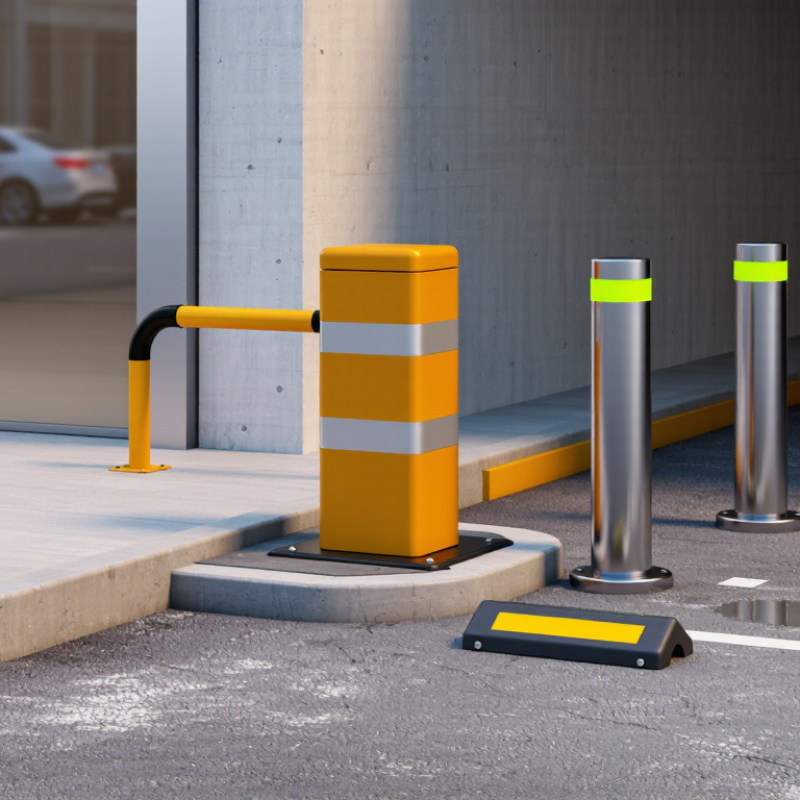
Steel Bollard Types: Fixed, Removable, and Retractable Models
Steel bollards differ less by appearance than by how they meet daily access needs. Fixed models suit entrances, loading areas, and pedestrian edges where vehicle access should stay blocked. Their strength depends on the whole installation: bollard, footing, soil, and spacing. A thick steel post in weak concrete can disappoint. Details matter.
Removable bollards use a ground sleeve, letting staff clear a lane for deliveries or events. They are practical, but lifting and storing posts takes time; covers can also collect grit and water. Retractable models lower into the pavement, keeping paths clear when access is open. Manual units avoid power systems, while powered versions offer easier operation but need maintenance. Not every site needs automation.
For impact protection, compare tested performance rather than steel thickness alone. ASTM F2656/F2656M evaluates vehicle-impact performance using factors including vehicle mass, impact speed, and penetration distance; ask for test documentation matching the proposed assembly. NHTSA’s 2022 Traffic Safety Facts recorded 7,522 pedestrian deaths in the United States, a sobering reminder that site design deserves careful review. That figure does not measure bollard effectiveness. It does reinforce the value of assessing vehicle paths, sightlines, and pedestrian exposure before choosing fixed, removable, or retractable posts.
What Are the Best Steel Parking Bollards? — Steel Bollard Types: Fixed, Removable, and Retractable Models
Compare common steel bollard types by installation, access, upkeep, and typical applications. Specifications vary by design and manufacturer; confirm project requirements before selection.
| Comparison | Fixed Steel Bollards | Removable Steel Bollards | Retractable Steel Bollards |
|---|---|---|---|
| How they work | Permanently anchored in place, commonly in a concrete foundation or with a surface-mounted base. | Lifted out of a ground socket when vehicle access is needed; a cover can close the socket when the post is removed. | Lowered into a below-ground housing and raised when access needs to be restricted. Operation may be manual, hydraulic, or electromechanical. |
| Access control | Continuous; the bollard cannot be moved during normal use. | Occasional or scheduled access, with removal and replacement performed by an authorized person. | Frequent or controlled access; automated versions can be operated from a control system. |
| Typical installation | Requires suitable anchorage and, for embedded models, excavation and concrete work. | Requires a compatible receiver socket, accurate alignment, and suitable drainage or debris management. | Requires an underground mechanism, sufficient excavation depth, drainage, and access for servicing. |
| Typical materials | Carbon steel or stainless steel. Carbon steel is often galvanized, painted, or powder-coated for corrosion protection. | Steel post with a matching steel receiver; protective finishes depend on the environment and product design. | Steel post with a below-ground housing and operating mechanism; finish and internal components vary by model. |
| Strength considerations | Can provide strong vehicle protection when the bollard, foundation, spacing, and installation are designed for the required impact level. | Performance depends on the post, receiver, locking arrangement, and foundation; not every removable model is impact-rated. | Security performance varies widely. An automatic or retractable design should not be assumed to be impact-rated without documented test information. |
| Maintenance needs | Usually low; inspect the finish, anchorage, and surrounding pavement periodically. | Keep the socket clear of dirt, water, and debris; inspect the post and locking components. | More involved; inspect the operating mechanism, drainage, electrical or hydraulic components, and safety controls as applicable. |
| Typical applications | Permanent protection for building entrances, sidewalks, storefronts, and parking areas. | Driveways, service routes, or access points that are normally closed but need occasional vehicle access. | Busy entrances, managed parking areas, and sites where access needs to be changed frequently or remotely. |
| Relative installation complexity | Low to moderate, depending on foundation and surface conditions. | Moderate; the ground socket must be installed accurately and kept usable. | High; underground housing, drainage, power or hydraulic supply, and controls may be required. |
| Best suited to | Locations where the barrier should remain in place at all times. | Locations that need a simple, removable barrier without a powered mechanism. | Locations that require frequent operation and have the budget and maintenance capability for a more complex system. |
Selection tip: Check required impact performance, local accessibility and fire-access rules, underground utilities, soil and drainage conditions, visibility needs, and ongoing maintenance capacity. Appearance alone is not evidence of vehicle-impact resistance.